I almost titled this, “Just because it feels bad, doesn’t mean it IS bad” (shout out to Jessica Lanyadoo).
But then I remembered this meme:
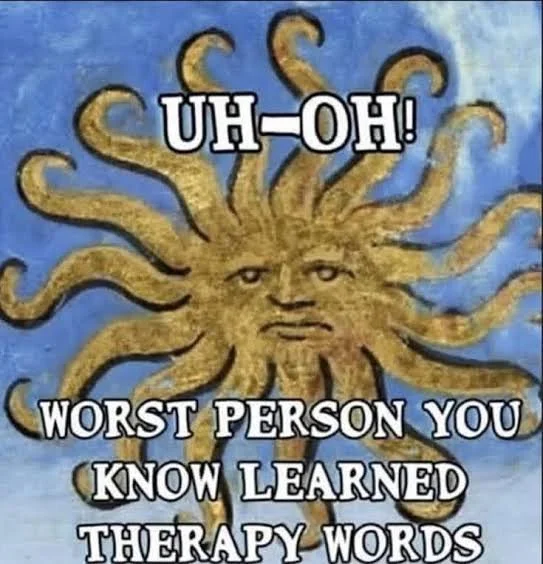
More people, particularly younger people, are seeking psychotherapy. Yayyy! We love it! We have more language than ever to describe our emotional lives, our attachment styles, boundaries, trauma responses,etc etc.
And yet, the data tells us we're lonely.
Hmmm.
Better ways to access and describe our interiority - but perhaps the trade off, at this phase of consciousness anyway is that - the ways we've learned to think/talk about ourselves are actually making it harder to be with other peoples’ differences.
Scroll for five seconds on IG, and you'll encounter endless reassurance that your feelings are “valid,” your "boundaries” are sacrosanct, and the people who have hurt you are narcissists.
People can be cruel, manipulative, and cause real heartache. Learning to recognize mistreatment is vital work, but something equally vital gets lost when we become so interested in identifying who’s hurt us and how - that we stop wondering about our own participation in our relationships.
Being human is weird and hard. We hurt people we love. We misunderstand one another. We project our unconscious material onto unsuspecting friends, lovers, and colleagues. We disappoint people, and they disappoint us.
And here I am going to borrow from Jessica Lanyadoo: Just because something feels bad doesn't mean it is bad.
A friend challenging your behavior might feel like rejection. A partner expressing disappointment might stir up shame. A therapist offering an interpretation that doesn't sit comfortably might leave you feeling angry, exposed, or misunderstood (been there/done that!).
None of these experiences is evidence that something has gone wrong- sometimes its proof that something important is happening.
… Which brings me to therapists.
We're a strange bunch.
I don't know many people who enter this profession without some complicated relationship to their own suffering. The drive to try to understand ourselves, our parents, or the bewildering emotional environments in which we grew up urged us towards our callings, or at least therapy school
Our wounds can become extraordinary instruments of empathy- but they can also get in the way.
A therapist who grew up feeling chronically invalidated may have a powerful unconscious investment in making sure their patients never (!) feel invalidated.
Another therapist who knows what it's like to be abandoned may find themselves reluctant to challenge a patient for fear of becoming another abandoning figure (or sitting with their own discomfort/fear of “rocking a boat”).
This is countertransference in action. Left unexamined, it can turn psychotherapy into something more like a mutual reassurance society - which in this psychotherapist’s opinion at least - is quite dangerous.
Winnicott understood that the capacity to tolerate frustration, even hate, is an essential part of emotional development. Bion understood that “being real” requires us to bear emotional experiences we might otherwise rush to flee.
Of course, therapy should be safe. !
But safety does not equal comfort. Validation - while sometimes quite necessary in the room - is not the same thing as understanding.
Back to “the loneliness epidemic” - I worry that we're becoming very good at naming what other people do to us, and less skilled at remaining in relationship when things become difficult.
Loneliness has many causes: economic pressures causing exhaustion, disappearing communities/third spaces, invasive/ addictive technology... To be clear - I don't think psychotherapy is responsible for the loneliness epidemic.
But I do think me and my colleagues out there ought to ask ourselves whether we're always helping our patients… The goal of psychotherapy isn't to convince someone that they're right, good, or blameless. It's to help them become more capable of knowing themselves, including and especially: the parts they'd rather not know.
Data on loneliness: